
Overview
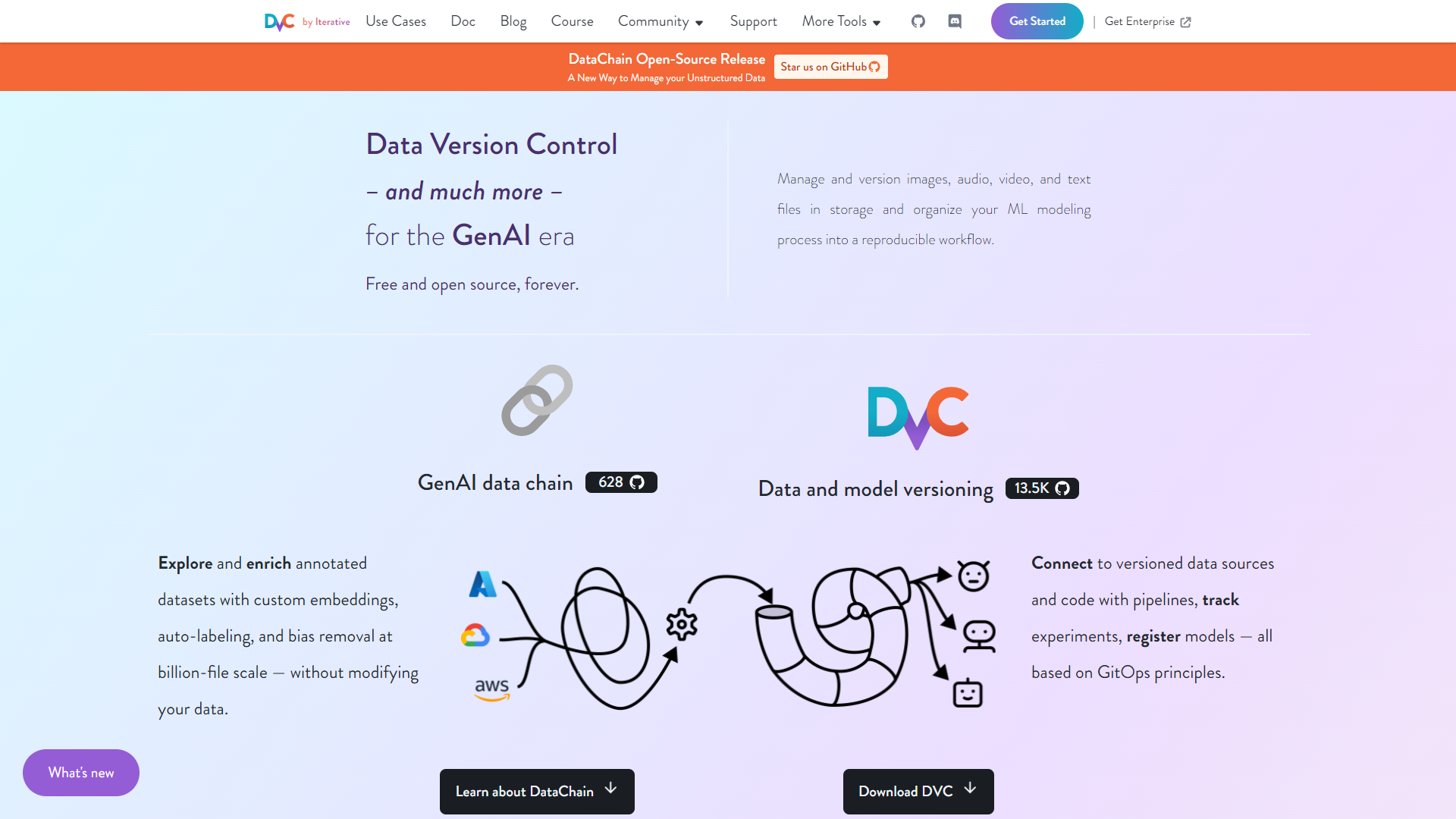
DVC, or Data Version Control, is an open-source tool designed to streamline the management of machine learning datasets. It allows users to version control their data, code, and models, ensuring that every change is tracked and reproducible. With DVC, teams can collaborate more effectively, reducing confusion and enhancing productivity in data science projects.
Pros
- Enhances Team Collaboration
- Simplifies Experiment Tracking
- No Additional Cost
- Flexible
- Improves Project Organization
Cons
- Steep Learning Curve
- Requires Git
- Limited GUI
- Performance Issues
- Compatibility Concerns
Clone DVC with AI
Create your own version of DVC — no coding needed. AI builds it for you in minutes.
Key features
Data Versioning
DVC allows users to keep track of changes in datasets, making it easy to revert to previous versions if needed.
Integration with Git
DVC works seamlessly with Git, adding data versioning capabilities to your existing workflows.
Pipeline Management
Users can define data processing pipelines, tracking all stages from raw data to model training.
Cloud Storage Support
DVC supports various cloud storage options for data storage, improving accessibility and collaboration.
Reproducibility
By keeping a detailed record of experiments, users can ensure that results can be reproduced accurately.
Collaboration Tools
DVC makes it easy for teams to share data and models, fostering a collaborative environment.
Performance Optimization
DVC is designed to work efficiently with large datasets without slowing down project workflows.
Open-Source and Free
Being open-source, DVC is free to use, making it an accessible option for everyone.
Rating Distribution
User Reviews
View all reviews on G2Great support from DVC team; flexible and very helpful tool
What do you like best about DVC?
DVC allowed me to have an overview of my results, with plots and tracking the metadata. This improves and speeds up the research process, allowing reproducibility of the results and better team work.
What do you dislike about DVC?
The tool needs some basic knowledge...
If you like the unix and open source philosophy, then with dvc you will feel home
What do you like best about DVC?
I like that they follow the UNIX philosophy quite closely, they have an amazing comunity, always there to answer your questions. I also find amazing the open source culture they cultivate, and the active role they play in the ML community, sometimes even supporting e...
DVC is an essential tool for anyone who wants to develop structured ML projects
What do you like best about DVC?
What I like most is that it fills a gap that no other tool out there does. It provides a way to version machine learning projects.
What do you dislike about DVC?
The learning curve of mixing Git and DVC can be a bit hard.
What problems is DVC solving and how is tha...
A great tool for data modeling
What do you like best about DVC?
A great framework for structuring pipelines that are meant to be run locally and quickly: lightweight, local-friendly and GitOps philosophy, can get a lot of value with zero code instrumentation.
What do you dislike about DVC?
Considerations of data processing at sc...
Manage your data like a pro!
What do you like best about DVC?
It makes the models I create using python so much more accessible and sharable , It also intuitively tracks ML model evolution beautifully. Also, Data management is on another level.
What do you dislike about DVC?
Trial Period is inadequate for learning the walkthro...
Company Information
Alternative Mlops Platforms tools
Explore other mlops platforms tools similar to DVC






FAQ
Here are some frequently asked questions about DVC.
What is DVC?
DVC stands for Data Version Control, a tool for managing datasets in machine learning projects.
How does DVC work with Git?
DVC integrates with Git to add data management capabilities to your existing version control workflows.
Is DVC free to use?
Yes, DVC is an open-source tool and is completely free to use.
Can DVC handle large datasets?
Yes, DVC is designed to work efficiently with large datasets, but performance may vary based on the setup.
What storage options does DVC support?
DVC supports various cloud storage providers, including AWS S3, Google Drive, and Azure.
Do I need to know Git to use DVC?
While it's helpful to understand Git, DVC does include documentation for users who are new to version control.
Can I use DVC for projects that are not machine learning?
DVC is primarily designed for machine learning, but it can be adapted for any project that requires data versioning.
What if I encounter issues while using DVC?
DVC offers detailed documentation and community support for troubleshooting and guidance.