

Overview
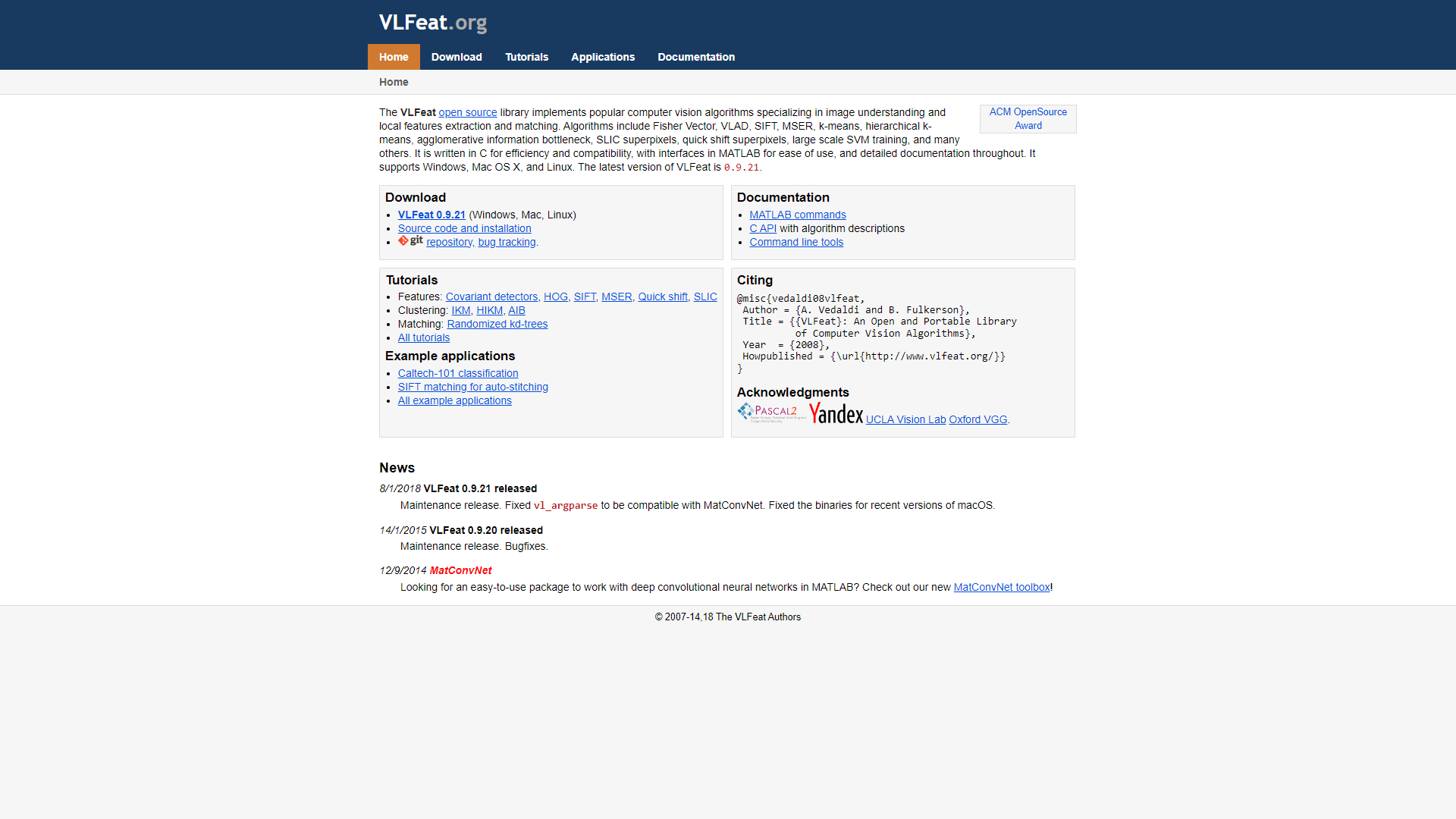
VLFeat is an open-source library designed for computer vision applications. It provides a wide range of algorithms and tools that help developers and researchers implement machine learning and computer vision techniques easily. With VLFeat, users can perform tasks such as feature extraction, clustering, and classification more efficiently.
The library is highly flexible, allowing users to extend its capabilities according to their specific needs. This makes it a preferred choice for many academic and industrial applications. VLFeat was built to be accessible and user-friendly, ensuring that both beginners and experienced users can leverage its features.
One of its standout characteristics is the emphasis on scalability and performance, enabling it to handle large datasets. Whether you're working on a small project or a more extensive system, VLFeat offers the tools needed to succeed in your computer vision tasks.
Pros
- Open Source
- Rich Documentation
- Supports Multiple Languages
- Active Community
- Versatile Applications
Cons
- Steep Learning Curve
- Limited Built-in Visualization Tools
- Not Always Up-to-Date
- Requires Programming Knowledge
- Occasional Compatibility Issues
Clone VLFeat with AI
Create your own version of VLFeat — no coding needed. AI builds it for you in minutes.
Key features
Feature Extraction
VLFeat includes various methods for extracting features like SIFT and HOG, making image analysis simpler.
Clustering Algorithms
It supports different clustering algorithms, helping to group similar data efficiently.
Object Recognition
The library provides tools for recognizing objects in images, enhancing vision systems.
Image Segmentation
Users can segment images to identify distinct parts, useful for many applications.
Machine Learning
VLFeat incorporates machine learning techniques, making it easy to implement complex models.
High Performance
The library is optimized for speed, allowing it to process large datasets quickly.
User-Friendly
It is designed with usability in mind, providing clear documentation and examples.
Cross-Platform
VLFeat can be used across different operating systems, increasing its accessibility.
Rating Distribution
User Reviews
View all reviews on G2Lacks Documentation Depth
What do you like best about VLFeat?
Vlfeat is so cool. A computer vision researcher of the VLFeat will be a glad guy. It massively widens the choice of perfectly crafted blocks for the image recognition, like SIFT and Fisher Vectors. Here, they can be simply grabbed and built over. Thus, this open-s...
An extensive computer vision library
What do you like best about VLFeat?
Many good baselines for popular computer vision techniques such as SIFT and HOG, along with a good SVM implementation. Also good documentation.
What do you dislike about VLFeat?
Doesn't support more recent deep learning techniques (but see Matconvnet). Requires M...
Company Information
Alternative Image Recognition tools
Explore other image recognition tools similar to VLFeat



-logo.png)

FAQ
Here are some frequently asked questions about VLFeat.
What is VLFeat?
VLFeat is an open-source library that provides tools for computer vision and machine learning tasks.
Is VLFeat free to use?
Yes, VLFeat is an open-source library, so it is free to use and modify.
What programming languages does VLFeat support?
VLFeat primarily supports C, but it also has interfaces for MATLAB and Python.
Can I use VLFeat for real-time applications?
Yes, VLFeat is optimized for performance, making it suitable for real-time applications.
Where can I find documentation for VLFeat?
Documentation for VLFeat is available on its official website, which includes guides and examples.
Does VLFeat support any specific operating system?
VLFeat is cross-platform, so it can be used on various operating systems like Windows, macOS, and Linux.
How can I contribute to VLFeat?
You can contribute by providing feedback, reporting bugs, or even adding new features through its GitHub repository.
Is there a community or forum for VLFeat users?
Yes, there is an active community that discusses issues and shares knowledge related to VLFeat.