
Overview
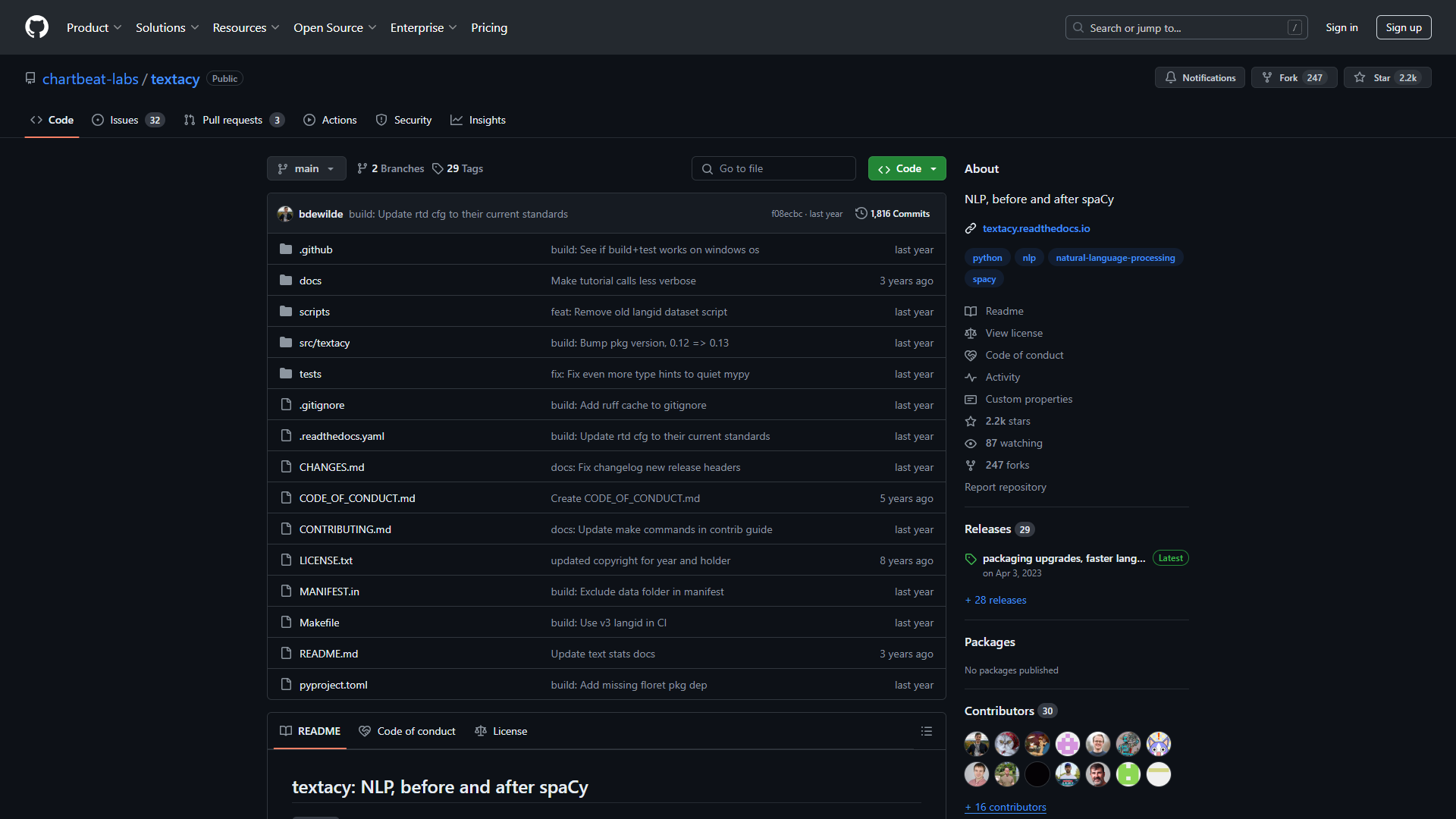
Textacy is a Python library that combines the capabilities of spaCy and other text processing tools to help users analyze and work with large amounts of text. It is designed for those who want to perform natural language processing (NLP) in a more efficient way. With Textacy, users can easily manipulate text data and extract valuable insights from it.
The library provides various features such as text preprocessing, vectorization, and topic modeling. This makes it useful for researchers, data scientists, and anyone interested in understanding large text datasets. Textacy simplifies complex NLP tasks, allowing users to focus on analysis rather than getting bogged down in the details.
Additionally, Textacy is open-source, which means that it is constantly being improved by a community of developers. This ensures that users have access to the latest tools and techniques in text analysis. Its compatibility with spaCy also means that it can leverage the power of advanced models for better text understanding.
Pros
- Easy to use
- Rich documentation
- Active community
- Powerful features
- Fast processing
Cons
- Requires Python
- Limited support for non-English languages
- Steep learning curve for advanced features
- Dependency on spaCy
- Lack of graphical interface
Clone textacy with AI
Create your own version of textacy — no coding needed. AI builds it for you in minutes.
Key features
Text Preprocessing
Textacy provides robust tools for cleaning and preparing text data for analysis, including lowercasing, removing punctuation, and tokenization.
Named Entity Recognition
It uses spaCy's advanced models to identify and extract named entities from text, such as people, organizations, and locations.
Topic Modeling
Textacy includes methods for discovering underlying themes in a set of documents, helping users understand the main ideas in their text data.
Text Vectorization
The library offers different techniques to convert text into numerical data, making it easier to analyze and visualize.
Collocation Extraction
Users can identify frequently occurring words and phrases, which can provide insights into the context and themes of the text.
Similarity Scoring
Textacy allows users to measure the similarity between texts, valuable for clustering or deduplication tasks.
Custom Pipelines
Users can create custom NLP pipelines tailored to their specific needs, using the flexibility of spaCy's architecture.
Integration with Other Tools
Textacy is designed to work smoothly with other libraries like pandas and scikit-learn, enhancing its usability.
Alternative Conversational Intelligence tools
Explore other conversational intelligence tools similar to textacy





FAQ
Here are some frequently asked questions about textacy.
What is Textacy?
Textacy is a Python library designed for natural language processing and text analysis.
How can I install Textacy?
You can install Textacy using pip by running the command `pip install textacy`.
What programming language does Textacy use?
Textacy is built using Python, so you will need some knowledge of Python to use it.
Can I use Textacy with non-English texts?
While Textacy primarily supports English, some features can be used for other languages, though results may vary.
What are the main features of Textacy?
Textacy offers text preprocessing, named entity recognition, topic modeling, text vectorization, and more.
Is Textacy open-source?
Yes, Textacy is open-source, allowing users to contribute and benefit from community improvements.
Do I need spaCy to use Textacy?
Yes, Textacy is built on top of spaCy, so you need to install it to use Textacy.
What kind of projects can I do with Textacy?
You can perform various text analysis projects, including sentiment analysis, clustering documents, and extracting keywords.
Where can I find documentation for Textacy?
You can find detailed documentation on the Textacy GitHub page, which guides you through installation and usage.