Stanford Part-Of-Speech Tagger
An advanced tool for understanding language structure.
Overview
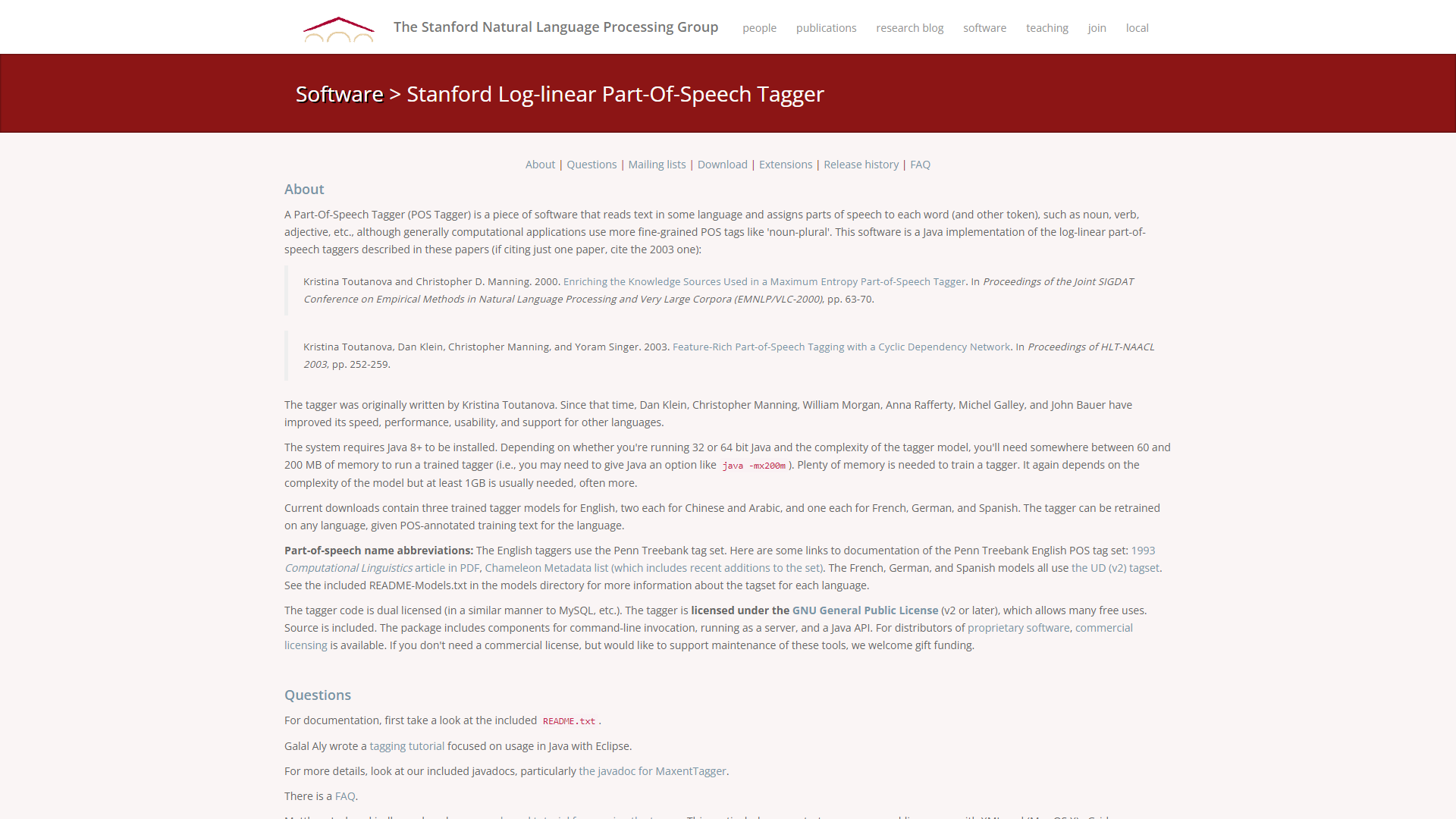
The Stanford Part-Of-Speech Tagger is a tool designed to assign parts of speech to each word in a text. It helps computers understand the structure of sentences by identifying nouns, verbs, adjectives, and more. This is crucial for many language processing tasks like translation, sentiment analysis, and data mining.
Using machine learning methods, the tagger is trained on large datasets, making it effective for a wide range of applications. Whether you are a developer or a researcher, it can enhance your projects by providing a deeper understanding of text. The tagger supports multiple languages, increasing its usefulness in diverse contexts.
Moreover, the Stanford Tagger is open-source, meaning it is free to use and can be modified to fit specific needs. It's a popular choice in both academic and commercial settings. This tool is especially beneficial for those looking to analyze language patterns more effectively.
Pros
- Free to Use
- High Performance
- Wide Language Support
- Versatile Applications
- Active Community
Cons
- Learning Curve
- Resource Intensive
- Limited to Text Inputs
- Dependency Management
- Manual Annotation Needed
Clone Stanford Part-Of-Speech Tagger with AI
Create your own version of Stanford Part-Of-Speech Tagger — no coding needed. AI builds it for you in minutes.
Key features
Multi-language Support
The tagger works with various languages like English, Spanish, and Chinese, making it versatile for international projects.
Machine Learning Approach
It utilizes advanced machine learning techniques, which help it improve over time with more data.
Open-Source Availability
Being open-source allows users to download and customize the software without any cost.
User-Friendly Interface
Its straightforward interface makes it easy for both experts and beginners to use.
High Accuracy
The tagger boasts high accuracy in assigning the correct parts of speech to words, a key factor for effective language processing.
Compatible with Other Tools
It can easily integrate with other Stanford NLP tools for enhanced language analysis.
Customizable Models
Users can train their own models using specific datasets to better suit their needs.
Comprehensive Documentation
The tool comes with detailed documentation, which aids users in understanding its functionalities and features.
Rating Distribution
User Reviews
View all reviews on G2Analyze and classify language with Inaccurcy
What do you like best about Stanford Part-Of-Speech Tagger?
The user interface of the Stanford Part Of Speech Tagger is hectic. Its not easy to use. I have faced many problems so far. The developers have done a job with this application leaving little room, for criticism. It does not consistently pr...
Stanford Part-Of-Speech Tagger review
What do you like best about Stanford Part-Of-Speech Tagger?
How easy and intuitive the software is. Seeing how much work went into this project is just incredible!
What do you dislike about Stanford Part-Of-Speech Tagger?
It is very intuitive and there is very little to dislike. I have yet to exper...
A Language Analysis Tool: Stanford Part-Of-Speech Tagger
What do you like best about Stanford Part-Of-Speech Tagger?
Its exceptional accuracy and precision. The tool utilizes advanced machine learning algorithms and linguistic rules to assign part-of-speech tags to words in a given text with remarkable accuracy
What do you dislike about Stanford Part-Of-...
Easy to understand and implement
What do you like best about Stanford Part-Of-Speech Tagger?
the best thing is the way it assigns values to part of speech which make it easy to understand by NLP what it wants to do.
What do you dislike about Stanford Part-Of-Speech Tagger?
Can be more advance and speed can be the issue at large am...
Stanford Part-Of-Speech Tagger
What do you like best about Stanford Part-Of-Speech Tagger?
Unique tagged for each part of speech like noun, pronoun, verb etc. help the development understanding clearly and convert as required without any error
What do you dislike about Stanford Part-Of-Speech Tagger?
Nothing such yet as it's ver...
Company Information
Alternative Conversational Intelligence tools
Explore other conversational intelligence tools similar to Stanford Part-Of-Speech Tagger





FAQ
Here are some frequently asked questions about Stanford Part-Of-Speech Tagger.
What is a Part-Of-Speech Tagger?
A Part-Of-Speech Tagger assigns parts of speech like nouns and verbs to each word in a sentence.
Is the Stanford Tagger free to use?
Yes, the Stanford Part-Of-Speech Tagger is open-source and free.
Which languages does the Stanford Tagger support?
It supports multiple languages such as English, Spanish, and Chinese.
Can I customize the Tagger for my needs?
Yes, you can train your own models to fit specific datasets.
How accurate is the Stanford Tagger?
It boasts high accuracy, making it reliable for many language tasks.
What tools can I integrate with the Tagger?
It can easily integrate with other Stanford NLP tools for enhanced analysis.
Do I need programming skills to use it?
Some programming knowledge is helpful, but the user-friendly interface aids beginners.
How can I get support for the Tagger?
You can find help from the active community or through its comprehensive documentation.