
Overview
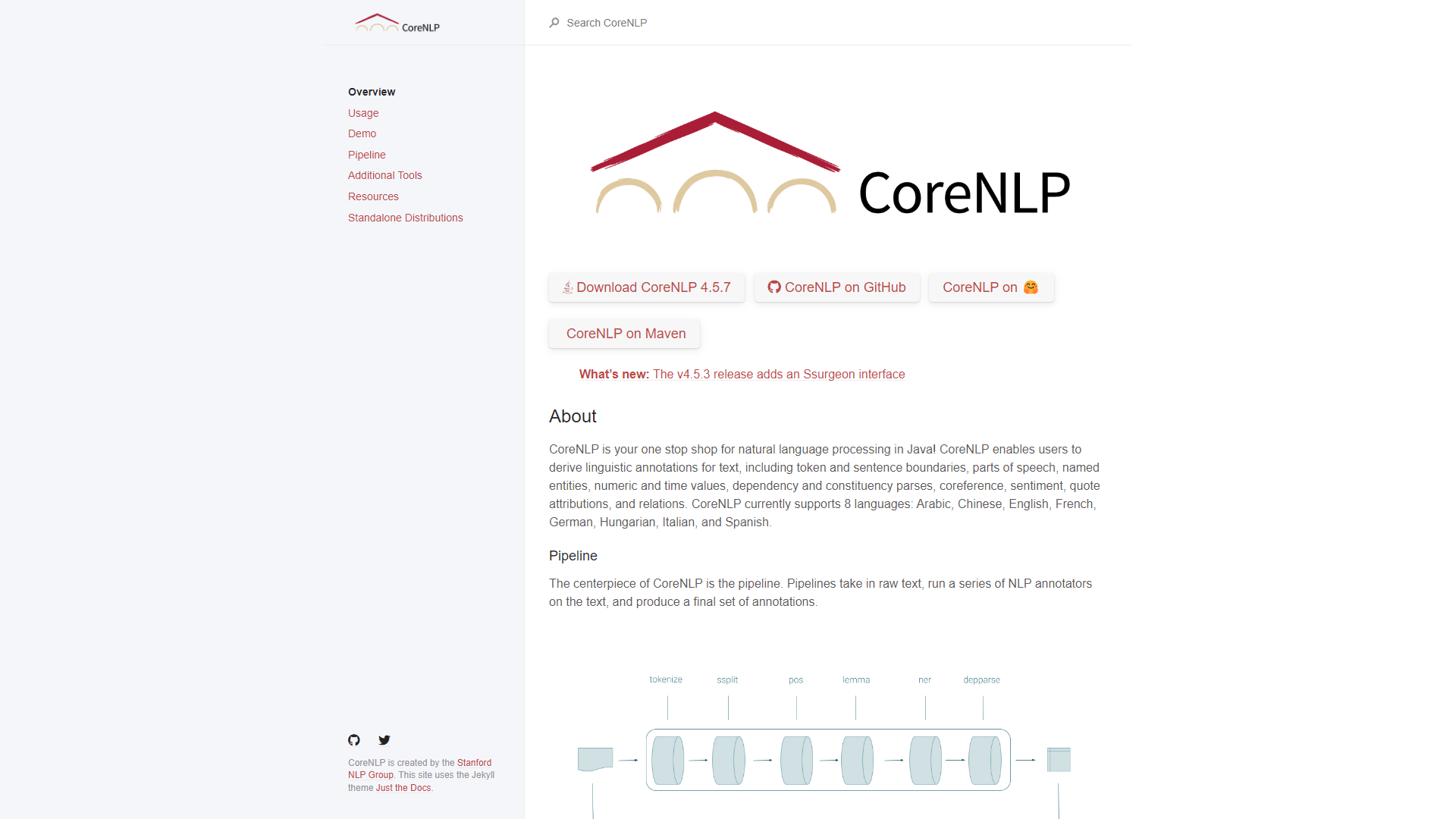
Stanford CoreNLP is a comprehensive toolkit designed for processing and analyzing natural language text. It offers a wide range of functionalities, such as tokenization, part-of-speech tagging, and named entity recognition, making it suitable for both researchers and developers. This open-source library is built on Java, providing a robust and flexible framework for various types of text analysis tasks.
The toolkit is especially helpful for those working with large datasets, as it can efficiently handle complex language structures and produce precise results. Developers appreciate its integration capabilities as it can be easily combined with other programming languages and tools. With a strong community behind it, Stanford CoreNLP is continually updated and improved, ensuring it remains relevant in the fast-evolving field of natural language processing.
Further, Stanford CoreNLP is known for its accuracy and speed. It supports multiple languages, allowing users from different linguistic backgrounds to utilize its features. Whether you're conducting sentiment analysis, building chatbots, or conducting linguistic research, this toolkit offers the functionalities you need.
Pros
- Comprehensive Features
- High Accuracy
- Free and Open Source
- Strong Community Support
- Versatile Use Cases
Cons
- Java Dependency
- Complex Setup
- Resource Intensive
- Limited User Interface
- Documentation Can Be Confusing
Clone Stanford CoreNLP with AI
Create your own version of Stanford CoreNLP — no coding needed. AI builds it for you in minutes.
Key features
Tokenization
Splits text into individual words or sentences for easier analysis.
Part-of-Speech Tagging
Identifies the grammatical roles of words in sentences.
Named Entity Recognition
Detects and classifies named entities like people, organizations, or locations.
Dependency Parsing
Analyzes relationships between words in a sentence to understand its structure.
Sentiment Analysis
Evaluates the sentiment behind text, categorizing it as positive, negative, or neutral.
Coreference Resolution
Identifies when different words refer to the same entity in the text.
Multi-language Support
Offers functionalities for various languages, not just English.
Integration with Other Tools
Can be combined with other libraries and frameworks for enhanced capabilities.
Rating Distribution
User Reviews
View all reviews on G2Develop a Working Understanding of Natural Langauge Processing
What do you like best about Stanford CoreNLP?
The Stanford Parser is an easy introduction to natural language processing (NLP). The program uses a combination of approaches to identify and tag both the individual components (syntax) within a sentence and to accurately assign the relationship between...
Natural Language parser with an ivy league touch
What do you like best about Stanford CoreNLP?
The Stanford Parser is a natural Language parser that doesn't require a ivy league degree to use; plus it is free; which is a huge plus; I use it surprising more than you would think, as i am currently trying to use it to feed langue into a Machine Learn...
Excellent, easy to use POS tagger
What do you like best about Stanford CoreNLP?
The amount of options that Stanford NER provides means you'll never go anywhere else for any kind of NER tasks
What do you dislike about Stanford CoreNLP?
The lack of good support of non-English languages
Recommendations to others considering Stanford ...
The simplest tokenizer to implement for NLP problems
What do you like best about Stanford CoreNLP?
Ease of use and implementation and works effectively in most cases. Open source license and straightforward algorithm.
What do you dislike about Stanford CoreNLP?
There are more powerful tools out there like spaCy which use deep learning techniques to i...
Java implemented NLP API for Named Entity Recognization by Stanford!!
What do you like best about Stanford CoreNLP?
it's an open source and very easy to use this library in java , it splits the sentence and gives the words(entity) as a result which actually makes sense like person,location etc , for using it into the java,
1) we need to import edu.stanford.nlp.* and ...
Company Information
Alternative Conversational Intelligence tools
Explore other conversational intelligence tools similar to Stanford CoreNLP





FAQ
Here are some frequently asked questions about Stanford CoreNLP.
What is Stanford CoreNLP?
Stanford CoreNLP is a toolkit for natural language processing that helps analyze and understand text.
Is Stanford CoreNLP free to use?
Yes, it is free and open-source, making it accessible to everyone.
What programming language is Stanford CoreNLP built on?
It is built using Java.
Can I use Stanford CoreNLP for different languages?
Yes, it supports multiple languages for processing text.
Is it easy to integrate Stanford CoreNLP with other tools?
Yes, it can be easily combined with other libraries and programming environments.
What are the main functionalities of CoreNLP?
CoreNLP includes tokenization, part-of-speech tagging, named entity recognition, and more.
How accurate is Stanford CoreNLP?
It is known for its high accuracy in natural language processing tasks.
Do I need technical skills to use Stanford CoreNLP?
Some basic programming knowledge is helpful, especially in Java.