
Overview
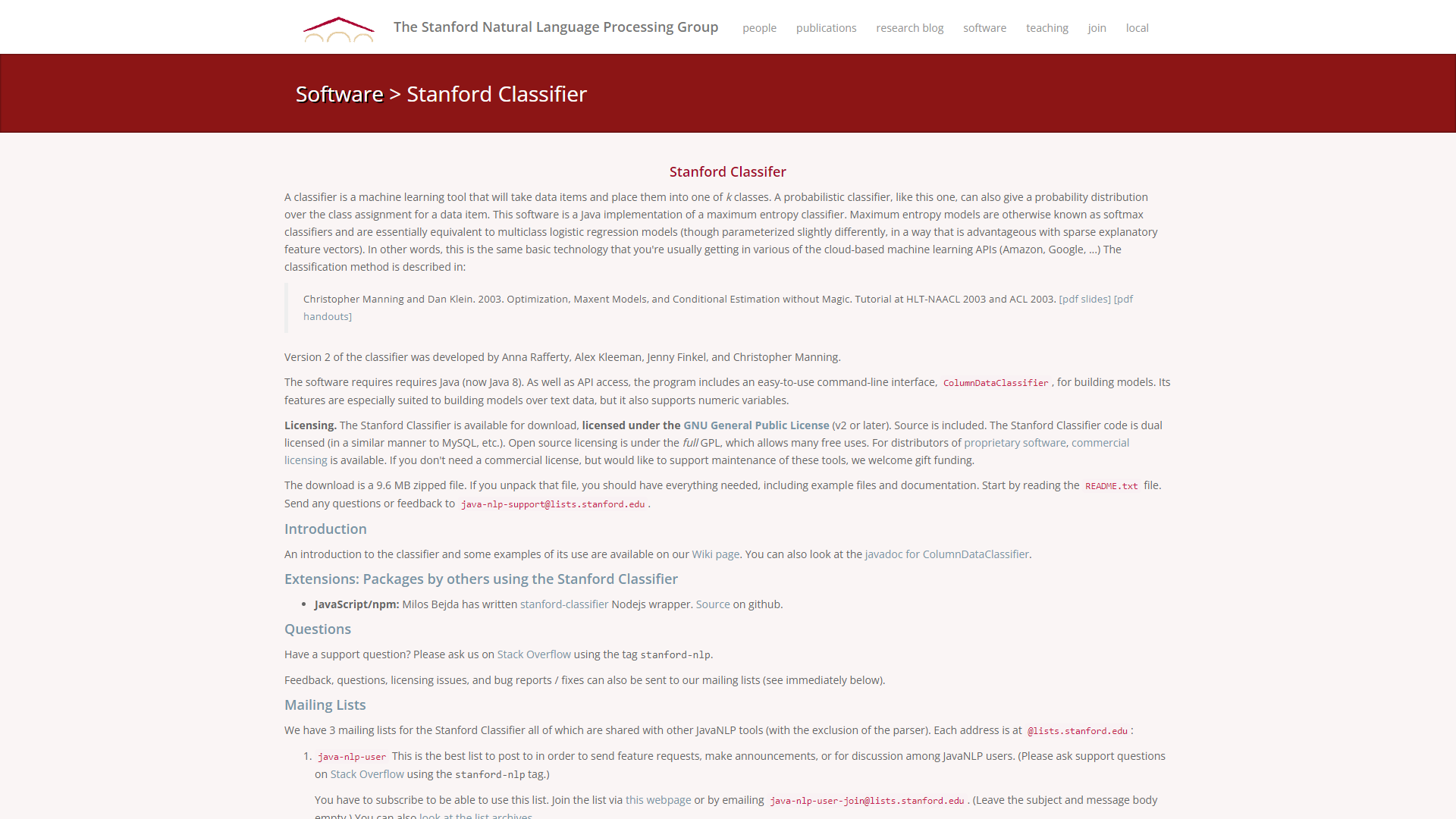
The Stanford Classifier is an advanced machine learning tool developed by the Stanford NLP Group. It is mainly used for text classification tasks but can be applied to various other domains. With its powerful algorithms, it allows users to train models that can categorize text efficiently. The tool is designed to be user-friendly, making it accessible for those with limited technical knowledge.
Pros
- Effective Performance
- Flexible Application
- Rich Documentation
- Open Source
- Large Community
Cons
- Steep Learning Curve
- Limited GUI Options
- Resource Intensive
- Configuration Complexity
- Documentation Overload
Clone Stanford Classifier with AI
Create your own version of Stanford Classifier — no coding needed. AI builds it for you in minutes.
Key features
Support for Various Algorithms
The Stanford Classifier supports multiple algorithms including Naive Bayes, Support Vector Machines, and Maximum Entropy.
Highly Customizable
Users can easily customize the parameters to adjust how the classifier learns from the data.
Pre-trained Models
The tool provides ready-to-use pre-trained models for popular tasks, saving time for users.
User-Friendly Interface
The interface is designed for ease of use, making it simple to upload data and run classifications.
Cross-Platform Compatibility
It runs on different operating systems such as Windows, macOS, and Linux.
Multilingual Support
The classifier can handle text data in multiple languages, broadening its use cases.
Built-in Evaluation Metrics
It includes tools to assess the performance of the classifier after training.
Strong Community Support
A large community around Stanford Classifier offers help and plugins for enhanced functionality.
Alternative Conversational Intelligence tools
Explore other conversational intelligence tools similar to Stanford Classifier





FAQ
Here are some frequently asked questions about Stanford Classifier.
What is the Stanford Classifier used for?
It is mainly used for text classification tasks such as categorizing emails and analyzing sentiments.
Is the Stanford Classifier free?
Yes, it is an open-source tool and can be used for free.
Can I use it for languages other than English?
Yes, the Stanford Classifier supports multiple languages.
What algorithms does the classifier support?
It supports algorithms like Naive Bayes, Support Vector Machines, and Maximum Entropy.
Do I need programming skills to use it?
Basic knowledge of programming can be helpful, but it is designed to be user-friendly.
How do I evaluate the model's performance?
The tool includes built-in evaluation metrics that help you assess the performance post-training.
Can I use pre-trained models?
Yes, the Stanford Classifier offers pre-trained models for some standard tasks.
Is there community support available?
Yes, there is a large community that actively shares knowledge and offers support.